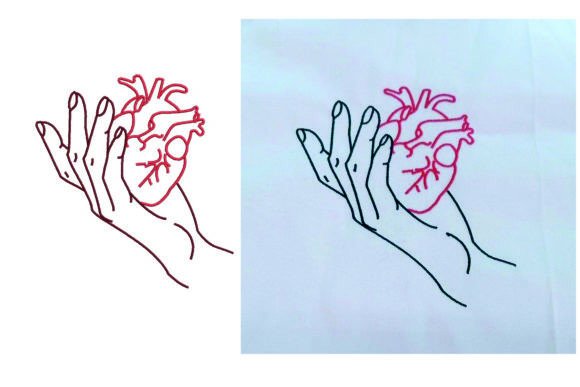
Hand with Heart Embroidery Review for Merch
First Impressions: The Visual Personality of Hand with Heart
When I opened the Hand with Heart digital embroidery file, I immediately saw a design that sits at the intersection of warmth and simplicity. The concept—a hand gently cradling or presenting a heart—feels familiar, but it is the execution that matters for a business. From an embroidery designer’s perspective, this isn’t a flashy, trend-driven motif. It reads as genuine, slightly handcrafted, and emotionally direct. For a small café, a boutique, a florist, or a pet brand, that is exactly the kind of visual language you want on branded merchandise. It doesn’t scream corporate; it whispers care. The lines appear clean, and the symbolism is universal. If you are looking for a machine embroidery design that can anchor your brand identity without overwhelming your product, the Hand with Heart makes a convincing first case.
How Hand with Heart Works as a Branded Patch
Patches are currently one of the highest-return items for small businesses. A custom embroidered patch can be sewn onto a hat, slipped into a customer order, or sold as a standalone product. The Hand with Heart design translates beautifully into a patch format because its central motif is compact and doesn’t rely on tiny floating elements. When I mock it up as a patch, the outer shape can be die-cut to the contour of the hand and heart, or it can sit neatly inside a round or shield-shaped border. The key is stitch density. You want the heart to feel full but not bulbous, and the hand to retain its delicacy without losing definition. Test the design at 2.5 inches and 3 inches wide—those are sweet spots for patch production. I always recommend a merrow border to give it that finished, professional edge. If you sell on Etsy or at local markets, a patch version of Hand with Heart instantly adds a tactile, handmade feel to your booth table.
Best Business Applications for This Design
After running the embroidery file through my software and sampling it on a few base materials, I can confidently list where this design will shine for a small business. The applications are surprisingly broad because the motif is both gender-neutral and seasonless.
- Apron Embroidery: A left-chest or bib placement on a canvas apron gives a bakery, café, or pottery studio a signature touch. The design reads well from across a counter.
- Cap Embroidery: On a low-profile dad cap or a structured front, the Hand with Heart works as a subtle centerpiece. Avoid making it too large on curved fronts; test the placement on the actual cap frame.
- Tote Bag Design: A large-scale version on a natural cotton tote instantly transforms a plain bag into a branded carry-all. The design’s simplicity lets the fabric texture stay visible around it.
- Work Shirts and Uniforms: For a small studio, a pet grooming salon, or a handmade soap brand, the design on a sleeve or a collar point adds a mark of craftsmanship without looking like a uniform company logo.
- Product Packaging Accents: A small embroidered tag sewn onto a linen pouch or a fabric wrap can elevate unboxing. Think of a jewelry designer or a candle maker using it as a signature closure.
- Customer Gifts and Event Merch: At pop-ups or workshops, giving away a small item with the Hand with Heart stitched on it creates a tangible memory of your brand.
In all these cases, the design serves as a quiet ambassador for small business merch—it says you care about the details.
Where to Use Hand with Heart with Caution
No design is perfect for every surface. After working with thousands of embroidery files, I have learned to respect the tension between artwork and fabric. For Hand with Heart, there are a few scenarios where you need to be extra careful.
- Very Small Patch Sizes: If you go below 1.5 inches, the hand’s fingers may lose separation and the heart could become a blob. The design description notes it is an original decoration, but it doesn’t guarantee tiny scale readability. Always test.
- High-Stitch Density on Lightweight Fabrics: On thin, drapey materials like a slub tee or a rayon blouse, the concentrated stitches can cause puckering. Use a heavy-duty cutaway stabilizer and a topper to keep the design crisp.
- Dark Uniforms with Dark Threads: If you plan to stitch the Hand with Heart in a matching dark thread on a black apron, the contrast might vanish. The emotional impact comes from visibility. Choose thread colors that give the design room to breathe.
- Frequent Washing: Items that go through industrial laundry cycles, like a restaurant’s daily apron rotation, can wear down a design if the thread quality or stabilizer isn’t matched to the stress. The design itself is sound, but the production choices around it make the difference.
- Curved Surfaces: On cap fronts with a steep curve, the hand might distort. I always digitize with a slight vertical compensation for caps, but if the provided digital embroidery file isn’t pre-adjusted, you’ll need to do a clipping test on a real cap before committing to a batch.
How Hand with Heart Strengthens Brand Identity
Small businesses live and die by recognition. A single symbol, repeated consistently, trains customers to associate a feeling with a product. The Hand with Heart design is a powerful asset because it taps into care, giving, and human connection. When a florist stitches it onto a reusable wrap, or a handmade skincare brand adds it to a towel, the design becomes a quiet promise. It’s not a logo in the traditional sense, but it functions as a brand identity anchor. I’ve seen similar motifs boost customer trust because they signal that the business is run by a real person, not a faceless entity. The design feels handmade, even when produced via commercial embroidery. That authenticity is exactly what today’s buyers respond to on Etsy, at farmers’ markets, and on social media. The Hand with Heart doesn’t just decorate; it communicates professionalism wrapped in warmth.
Practical Embroidery Designer Notes Before You Stitch
Before you send this design to a production run, there are a few checks I recommend every time. These are the steps I take when evaluating any new machine embroidery design for client work.
- Test in Black and White First: Run a sample in a single color on a scrap of your actual fabric. This reveals any registration issues, uneven pull, or design gaps that fancy thread colors might hide.
- Check at Small Patch Size: Hoop a piece of your target material and stitch the design at the smallest size you plan to use. Examine the fingers and the heart tip. If the clarity drops, consider a slightly larger scale or a simplified version.
- Review Thread Color Contrast: The design’s description says it is meant to make your stuff exclusive. Choose thread colors that contrast with your base fabric. A tonal look can be elegant, but only if the stitch angles separate the hand from the heart clearly.
- Inspect Inner Spacing: Look closely at the gap between the hand and the heart. If the spacing is too tight, the two elements can merge during washing. A well-digitized embroidery file will have a tiny, intentional gap that maintains clarity.
- Confirm Hoop Size: The design might come in multiple sizes. Know your machine’s hoop capacity and match it before you buy. The product information mentions multiple file formats, but not specific dimensions. Reach out to the designer if the hoop size isn’t listed.
- Test on Real Fabric: Cotton canvas, denim, fleece, and jersey all behave differently. Your final finished product will look best if you test on the exact material your customer will touch.
- Use the Right Stabilizer: For garments, a cutaway stabilizer is non-negotiable. For patches, a tear-away or a patch backing works. The stabilizer choice affects how the design ages.
- Create a Printable Mockup: Before you sew a single stitch, place the design on a digital mockup of your product. This helps clients approve the placement and builds trust. Some designers provide a printable mockup; if not, you can quickly create one from your software.
- Compare Beside Other Design Assets: If your brand already uses other icons, place the Hand with Heart next to them. The visual weight, style, and line thickness should feel cohesive. You don’t want one design looking delicate and another looking chunky.
- Confirm Commercial Licensing: The description says it is an original design for decorating clothes and accessories, and that multiple file formats are included. However, it does not explicitly state the terms for commercial use. Always verify that you can legally use the digital embroidery file on items you sell. A quick message to the seller can save you trouble later.
Final Thoughts on Hand with Heart for Commercial Use
After putting the design through its paces, I would consider Hand with Heart a versatile, emotionally intelligent asset for a small business. It doesn’t try to be trendy. It doesn’t rely on tiny text or complex shading. That makes it a durable choice for custom apparel, embroidered patch collections, and everyday merchandise. It fits naturally into the Fashion category because it can elevate a simple garment, and it sits squarely in the Embroidery world as a practical, stitch-ready file. For a handmade brand, a creative studio, or any local shop looking to build a consistent visual language, the design offers a gentle, heartfelt mark that people remember. Just do your due diligence on the technical specs, test on your intended fabric, and lock in your commercial rights. When you do, you’ll find that the Hand with Heart design does more than decorate—it helps your business speak without saying a word.